Best power bank for Steam Deck in 2026: five packs that deliver the 45 watts Valve asks for, and one number on the box you can ignore
Wattage is the whole story. A pack that cannot push 45W from one USB-C port will lose ground to a demanding game, however big the number on the box.

By Casey Morgan , Staff Writer, Consoles & Handhelds
When you buy through links on our site, we may earn an affiliate commission. Here is how it works.
The short version
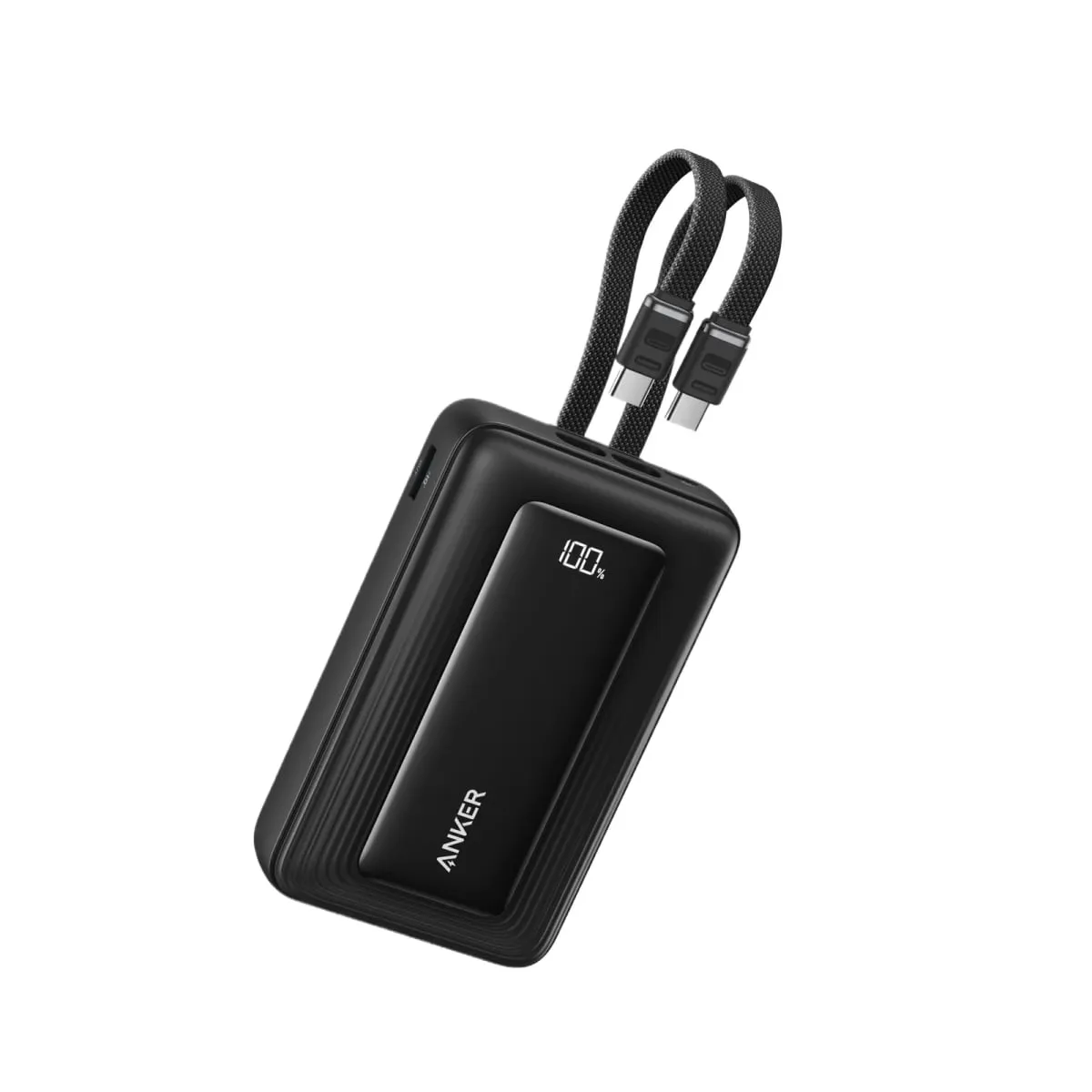
The best power bank for most Steam Deck owners is the Anker Zolo Power Bank (20K, 45W, Built-In Dual USB-C Cables). It supplies the full 45W the Deck accepts, holds about one full recharge of a Steam Deck OLED, and usually costs around $50. The smaller Anker Nano 10K 45W keeps the same speed at 8 ounces but stores about half as much.
Our picks at a glance
- Best value overall Anker Zolo Power Bank (20K, 45W, Built-In Dual USB-C Cables) Steam Deck owners who want full-speed charging and one real recharge for about $50Check price
- Best pocket-size pick Anker Nano Power Bank (10K, 45W, Built-In Retractable USB-C Cable) Commuters who want 45W in a jacket pocket and only need a few extra hoursCheck price
- Best for 65W handhelds UGREEN Nexode Power Bank 20000mAh 130W ROG Ally and Legion Go owners, or anyone charging a Deck and a phone at onceCheck price
- Best upgrade Anker Laptop Power Bank (25K, 165W, Built-In and Retractable Cables) Long-haul flyers who want the most playtime a carry-on comfortably allowsCheck price
- Best with a laptop Anker Prime Power Bank (26K, 300W) Travelers who carry a Steam Deck and a power-hungry laptop in the same bagCheck price

What is in this guide
- The best power bank for Steam Deck: our five picks
- 1. Anker Zolo Power Bank (20K, 45W, Built-In Dual USB-C Cables)
- 2. Anker Nano Power Bank (10K, 45W, Built-In Retractable USB-C Cable)
- 3. UGREEN Nexode Power Bank 20000mAh 130W
- 4. Anker Laptop Power Bank (25K, 165W, Built-In and Retractable Cables)
- 5. Anker Prime Power Bank (26K, 300W)
- What to look for in a power bank for Steam Deck
- Watts: why 45 is the number
- mAh versus watt-hours: how many charges you really get
- Can you fly with it?
- Pass-through charging, weight, and the cable
- Safety certification
- What about a power bank for ROG Ally or Legion Go?
- How we chose these power banks
- Which one should you buy?
The best power bank for Steam Deck owners is the one that can push 45 watts through a single USB-C port, because that is exactly what Valve’s handheld asks for. The Anker Zolo Power Bank (20K, 45W, Built-In Dual USB-C Cables) does it for about $50. It also holds roughly one full recharge of a Steam Deck OLED and carries its own cables.
The catch is sharing. Plug in a second device and the Zolo drops to 15W across everything, which a Deck running a big game will eat faster than it arrives.
If you want something that fits a jacket pocket, the Anker Nano 10K keeps the full 45W at about 8 ounces and stores half as much. And if you own a ROG Ally or a Legion Go, head for the UGREEN, because those handhelds want 65W or more.
The best power bank for Steam Deck: our five picks
1. Anker Zolo Power Bank (20K, 45W, Built-In Dual USB-C Cables)
Anker Zolo Power Bank (20K, 45W, Built-In Dual USB-C Cables)
Best for: Steam Deck owners who want full-speed charging and one real recharge for about $50
- Max USB-C output
- 45W from one cable or port
- Capacity
- 20,000mAh (about 72Wh)
- Real Deck OLED charges
- About 1
- Weight
- About 12.9 oz
- Cables
- Two built-in USB-C
Usually around $50
What we like
- Full 45W from either built-in cable or the USB-C port
- About one full Steam Deck OLED recharge for around $50
- Two built-in USB-C cables, so there is nothing to forget
What to know
- Output drops to 15W combined when two devices are plugged in
- Takes about 4 hours to refill with a 30W charger
- Older 30W Zolo models look almost identical
Valve’s Steam Deck tech specs list the charging input as a 45W USB-C Power Delivery supply. Power Delivery (PD) is the standard that lets a charger and a gadget agree on a higher voltage for faster charging. The Zolo offers that same 45W from either of its two built-in cables or from its USB-C port, so the Deck gets the wattage its own wall charger supplies.
Capacity is the other half. A 20,000mAh pack stores about 72 watt-hours, and after the losses we explain further down, roughly 50 of those reach the Deck. That is one full refill of the 50Wh OLED model, or about one and a quarter of the 40Wh LCD model. At about 12.9 ounces it weighs roughly what a full can of soda does.
Now the catch. With two devices connected, the Zolo cuts its total output to 15W, so charging a phone alongside the Deck slows both to a crawl. The built-in cables are short too (they tuck flat against the top of the pack), which suits a tray table better than a couch.
One shopping warning: Anker also sells older 30W Zolo packs that look nearly identical. Make sure the listing says 45W. Anker sells other Zolo variants too, so match the full name and the 20,000mAh capacity before you buy.
Skip the Zolo if you routinely charge two things at once. The UGREEN below handles that properly.
2. Anker Nano Power Bank (10K, 45W, Built-In Retractable USB-C Cable)
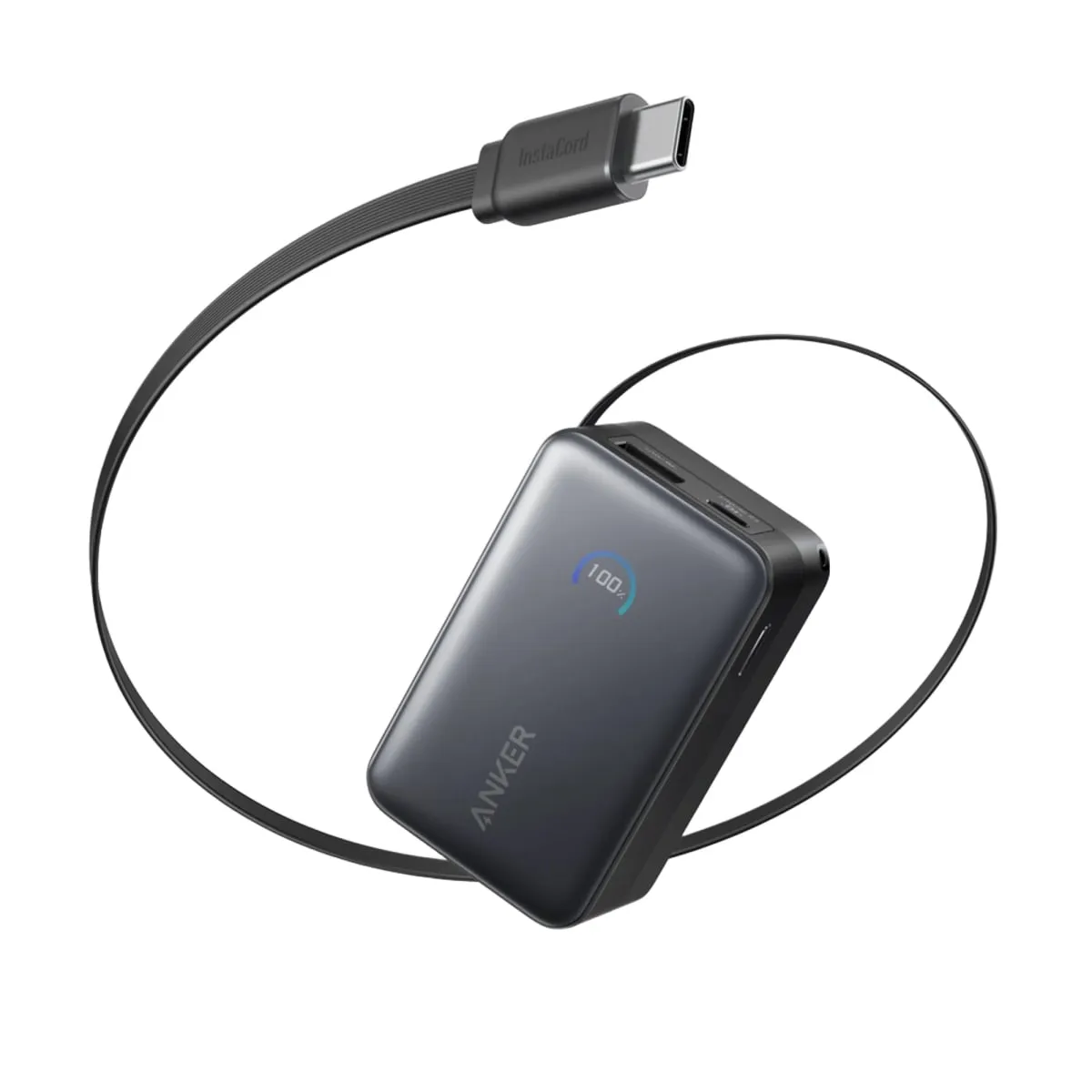
Anker Nano Power Bank (10K, 45W, Built-In Retractable USB-C Cable)
Best for: Commuters who want 45W in a jacket pocket and only need a few extra hours
- Max USB-C output
- 45W from the cable or port
- Capacity
- 10,000mAh (about 36Wh)
- Real Deck OLED charges
- About half
- Weight
- About 8.2 oz
- Cable
- 2.3 ft retractable USB-C
Usually $46 to $60
What we like
- Full 45W in a pack that weighs about 8 ounces
- The 2.3-foot retractable cable is the right length for handheld play
- Refills at up to 30W and can charge the Deck while it is plugged in
What to know
- Only about half a Steam Deck OLED recharge
- Costs about the same as the 20,000mAh Zolo
- Drops to 22.5W combined with two devices
Most 10,000mAh power banks top out at 20W or 30W, which is phone territory. The Nano is the rare small one that delivers a true 45W from its USB-C port or its built-in cable, so a Deck charges at full speed from a pack that measures about 3.2 by 2 by 1.4 inches and weighs about 8.2 ounces.
The retractable cable deserves its own mention. It pulls out to 2.3 feet, which is long enough to run from a hoodie pocket to the port on top of the Deck and short enough not to snag on an armrest. We have opinions about cable length, and this is the length.
The compromise is capacity. Its 10,000mAh works out to about 36 watt-hours, of which roughly 25 reach the Deck. That is half a refill for the OLED model. Valve rates the OLED Deck for 3 to 12 hours per charge depending on the game, so the Nano buys you somewhere between 90 minutes of a heavy shooter and several hours of a light indie game.
At a typical $46 to $60, it also costs about what the Zolo does with half the energy inside. You are paying for the size.
Buy it for commutes and short flights. Skip it for a cross-country trip, where the Zolo’s extra 5 ounces are worth carrying.
3. UGREEN Nexode Power Bank 20000mAh 130W
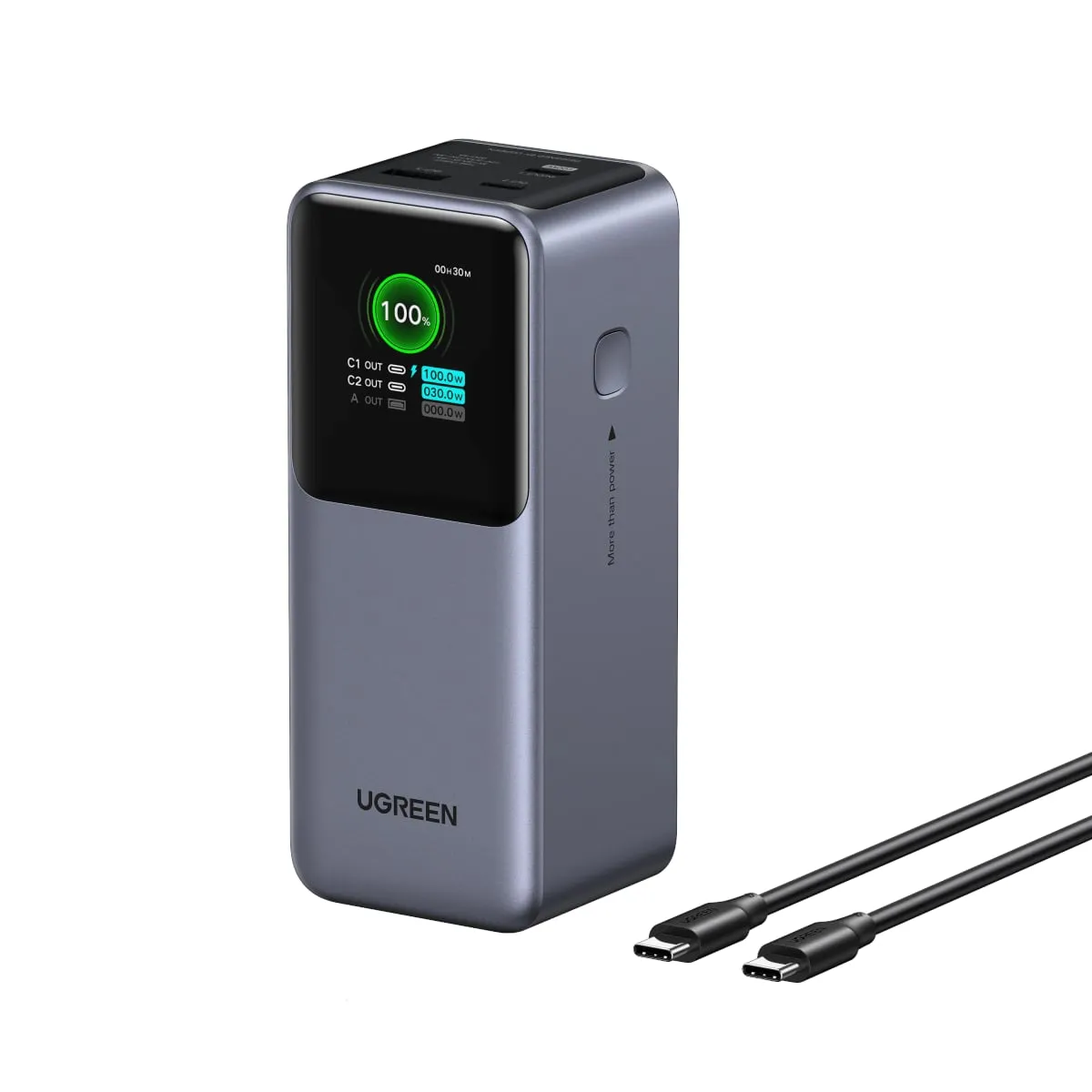
UGREEN Nexode Power Bank 20000mAh 130W
Best for: ROG Ally and Legion Go owners, or anyone charging a Deck and a phone at once
- Max USB-C output
- 100W from one port
- Second USB-C port
- 30W
- Capacity
- 20,000mAh (72Wh)
- Real Deck OLED charges
- About 1
- Weight
- About 17 oz
Usually $55 to $80
What we like
- 100W from one USB-C port covers 65W handhelds with room to spare
- Runs a Deck at 45W and a phone at 30W at the same time
- Refills at 65W, so it is ready again quickly
What to know
- About 4 ounces heavier than the Zolo for the same capacity
- No built-in cable, and it needs a 100W-rated one to reach full output
A Steam Deck cannot use more than 45W, so the UGREEN’s 100W main port will not charge it any faster than the Zolo does. What the extra wattage buys is headroom and sharing. The second USB-C port supplies 30W on its own, so the Deck can take its full 45W while a phone fast-charges next to it, which is the exact situation that trips up the Zolo.
It is also the pack we’d point ROG Ally and Legion Go owners toward. Those handhelds ship with 65W chargers, and a 100W port covers them with room to spare.
Capacity is the same 20,000mAh class as the Zolo, listed by UGREEN at 72Wh, so expect the same single OLED refill. The pack refills at 65W, which makes a quick top-up at the gate far more useful than it is with a 30W input.
The catches are weight and cables. At about 17 ounces it is roughly 4 ounces heavier than the Zolo for the same energy. There is no built-in cable either, and to carry more than 60W a USB-C cable has to be rated for 100W. A thin phone cable will quietly cap the output.
The list price is around $80, but it is often discounted to about $55, and at that price it is only a few dollars more than the Zolo. Skip it if you only ever charge a Deck and care about ounces.
4. Anker Laptop Power Bank (25K, 165W, Built-In and Retractable Cables)
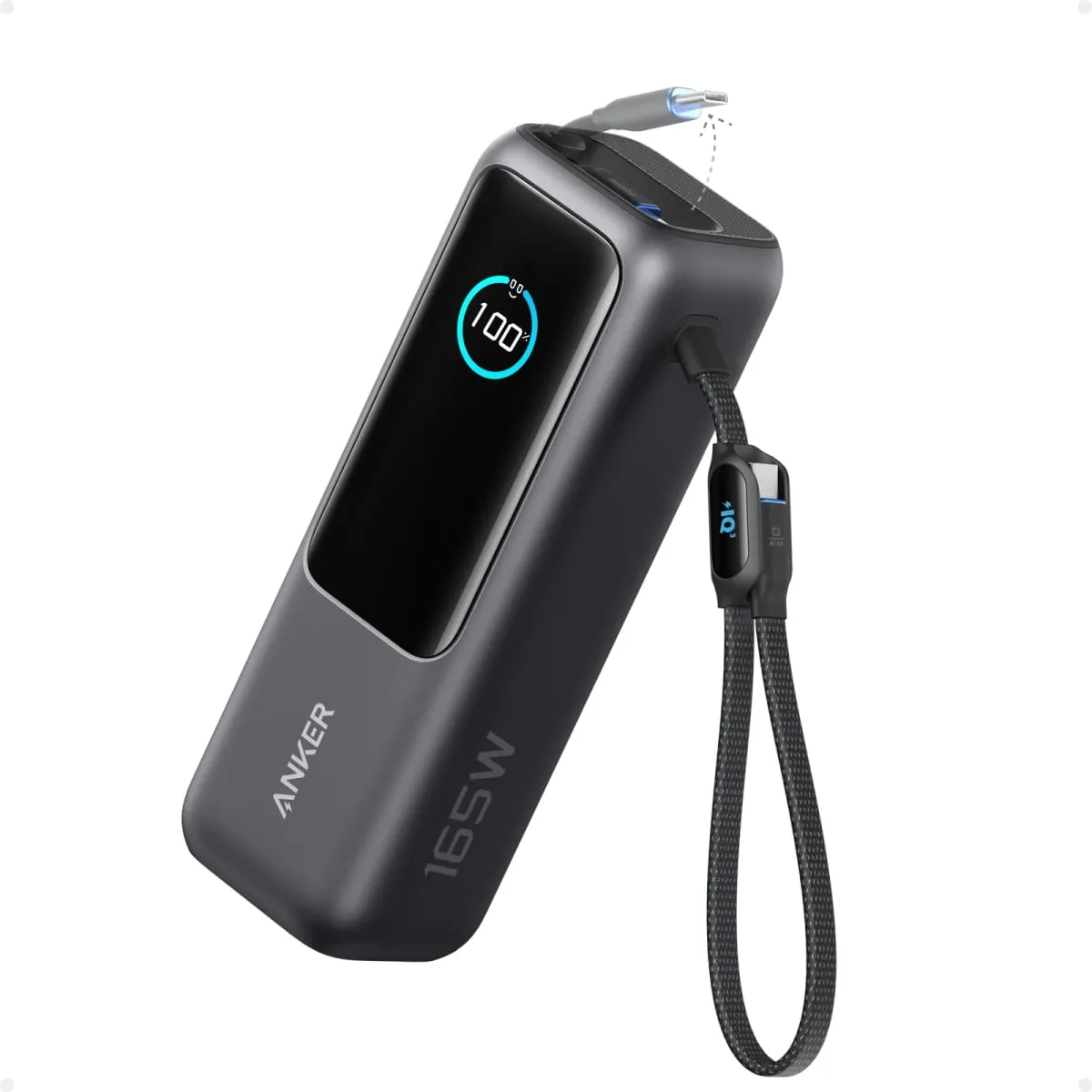
Anker Laptop Power Bank (25K, 165W, Built-In and Retractable Cables)
Best for: Long-haul flyers who want the most playtime a carry-on comfortably allows
- Max USB-C output
- 100W from one cable or port
- Capacity
- 25,000mAh (90Wh)
- Real Deck OLED charges
- About 1.3
- Weight
- 21 oz
- Cables
- Two built-in USB-C
Usually $90 to $120
What we like
- 90Wh rating stays under the 100Wh airline limit, with about 63 to 70Wh usable
- 100W from each built-in cable, 165W across two devices
- Refills in about 2 hours from a 100W charger
What to know
- At 21 ounces it weighs nearly as much as the Steam Deck itself
- Roughly twice the price of the Zolo for about a third more real capacity
This is the upgrade for people who measure trips in time zones. Its 25,000mAh battery is rated at 90Wh, comfortably under the 100Wh airline limit. Anker’s product page says to expect about 63 to 70Wh of usable output. For a Steam Deck OLED, that is roughly one and a third full recharges, and a bit more than one and a half for the LCD model.
It has two built-in USB-C cables (one retractable) and each can deliver 100W, with 165W available across two devices. A Deck or a ROG Ally gets everything it asks for, and the pack refills in about 2 hours from a 100W wall charger.
The catch is in your shoulder bag. At 21 ounces, this pack weighs nearly as much as the Deck, which Valve lists at about 640 grams (roughly 22.6 ounces). You are effectively carrying a second console that only does electricity.
Price is the other thing. It lists at about $120 and often sells near $90, which is roughly twice the Zolo’s price for about a third more real capacity.
Skip it if your longest session away from an outlet is a domestic flight. The Zolo covers that for half the money.
5. Anker Prime Power Bank (26K, 300W)
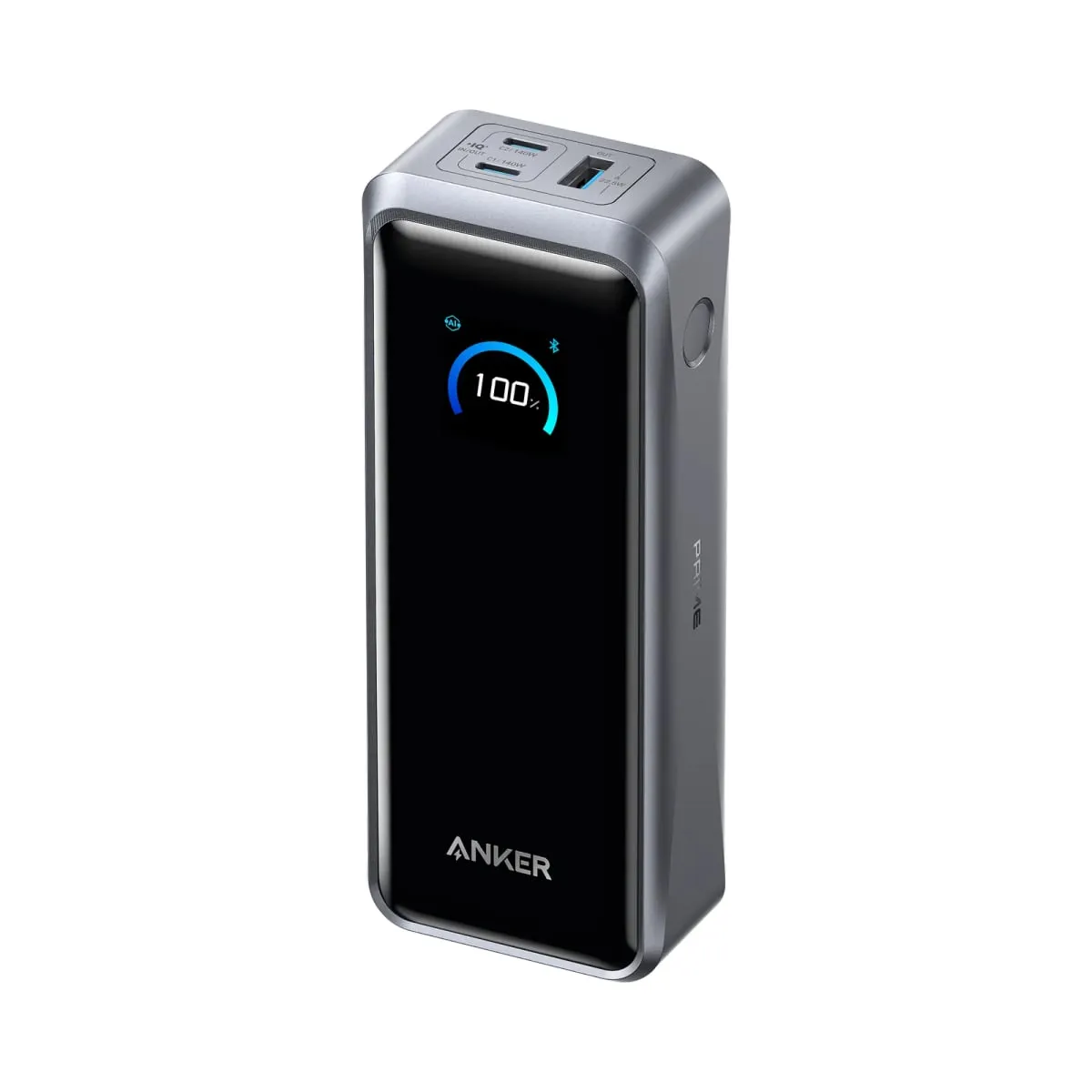
Anker Prime Power Bank (26K, 300W)
Best for: Travelers who carry a Steam Deck and a power-hungry laptop in the same bag
- Max USB-C output
- 140W from one port
- Capacity
- 26,250mAh (99.75Wh)
- Real Deck OLED charges
- About 1.4
- Weight
- 21 oz (1.32 lb)
- Cables
- None built in
Usually $160 to $230
What we like
- 99.75Wh is the most capacity that fits under the 100Wh airline limit
- 140W from one USB-C port runs a big laptop while a second port feeds the Deck
- 300W total across three ports
What to know
- Three to four times the price of the Zolo
- A Steam Deck uses less than a third of what one port can supply
- No built-in cable
For a Steam Deck on its own, the Prime is overkill. One of its USB-C ports can supply 140W. The Deck takes 45W. That is like buying a fire hose to fill a water glass.
It earns a place for one kind of traveler: the person with a Deck and a power-hungry laptop in the same bag. The Prime can run a big laptop from one port while a second feeds the Deck its full 45W. If that is you, our guide to bigger packs for laptops goes deeper on what a laptop needs.
Anker lists the capacity as 99.75Wh, as close to the 100Wh airline limit as a pack can get. That works out to roughly 1.4 Steam Deck OLED recharges after losses.
The price is the obvious catch. It lists at about $230 and commonly sells for around $160, three to four times what the Zolo costs. It weighs 1.32 pounds and has no built-in cable, so add a 100W-rated one to the bill.
Skip it unless a laptop is part of the plan. The Anker 25K above gives a Deck nearly the same playtime for about $70 less.
What to look for in a power bank for Steam Deck
A Steam Deck portable charger has one job that a phone charger does not: holding 45W for hours at a time.
Watts: why 45 is the number
Watts measure charging speed. The Deck accepts 45W, and while you play, part of that incoming power runs the game and only the leftover fills the battery. With 45W there is plenty left over. With an 18W or 20W phone pack, a demanding game can swallow nearly all of it, so the battery percentage crawls upward or slips backward, and the Deck may flag a slow charger. That is why a 45W power bank for Steam Deck use is the floor and not a luxury. Check the maximum from a single USB-C port, not the total across all ports printed on the box.
mAh versus watt-hours: how many charges you really get
Milliamp-hours (mAh) count charge at the battery cell’s own low voltage. Watt-hours (Wh) measure actual energy, and they are the only figure you can compare with the Deck’s 50Wh (OLED) or 40Wh (LCD) battery. A 20,000mAh pack holds about 72Wh. The pack then has to raise its voltage to charge the Deck, and that conversion sheds energy as heat. Going by Anker’s own figures for its 90Wh pack, between 70 and 78 percent gets through.
So the math is simple. Take the watt-hours, multiply by 0.7 (the cautious end), and divide by your Deck’s battery. For a 20,000mAh pack that is 72 times 0.7, or about 50Wh, which is one OLED refill and not the four that the big number on the box seems to promise.
Can you fly with it?
Yes, in your carry-on. The FAA limits spare lithium-ion batteries to 100Wh each without airline approval, and the TSA says power banks must go in carry-on bags, never checked luggage. Every pick here is under 100Wh. Airlines can set stricter rules, so check yours before an international trip.
Pass-through charging, weight, and the cable
Pass-through charging means the pack can charge the Deck while the pack itself is plugged into the wall, which is handy in a hotel room with one outlet. The Anker Nano supports it. It is a convenience, not a reason to choose a pack. Weight matters more, because the pack rides in the same bag as a console that already weighs about 1.4 pounds. A short cable, 2 to 3 feet, keeps the pack in a pocket without a loop of slack.
Safety certification
Buy from a brand that answers when something goes wrong, and look for a recognized safety certification (such as a UL listing) on the product or its store page. Our coverage of this month’s power bank recalls and warnings shows what happens with no-name packs.
| Power bank | Max from one USB-C port | Capacity | Real OLED charges | Weight | Typical price |
|---|---|---|---|---|---|
| Anker Zolo 20K 45W | 45W | About 72Wh | About 1 | 12.9 oz | Around $50 |
| Anker Nano 10K 45W | 45W | About 36Wh | About 0.5 | 8.2 oz | $46 to $60 |
| UGREEN Nexode 130W | 100W | 72Wh | About 1 | 17 oz | $55 to $80 |
| Anker Laptop 25K 165W | 100W | 90Wh | About 1.3 | 21 oz | $90 to $120 |
| Anker Prime 26K 300W | 140W | 99.75Wh | About 1.4 | 21 oz | $160 to $230 |
What about a power bank for ROG Ally or Legion Go?
Windows handhelds are hungrier than the Deck. ASUS ships the ROG Xbox Ally X with a 65W USB-C adapter and an 80Wh battery. Lenovo’s Legion Go and Legion Go 2 also come with 65W chargers, and the Legion Go line can take more. ChargerLAB’s Legion Go charging test measured the original model drawing about 62W from its stock charger and about 90W from a 100W charger, and found that a 30W charger could not charge it normally.
So a 45W power bank for a ROG Ally or Legion Go is a compromise. It sits below what the stock charger supplies, so a heavy game can outrun it. Get a pack with at least 65W from one port, and 100W if you own a Legion Go and want its fastest charging.
Capacity math changes too. The 50Wh that a 20,000mAh pack really delivers is about 60 percent of an Ally X battery, or about two thirds of the 74Wh Legion Go 2. The UGREEN is the value choice here. For closer to a full refill, the 90Wh Anker 25K is the one to carry.
How we chose these power banks
We started with Valve’s published 45W input and dropped every pack that could not supply at least that from a single USB-C port, which removed most of the cheap 20,000mAh field in one pass. From there we read manufacturer spec pages and support documents for the fine print that matters: per-port output, what happens when two devices share the pack, rated watt-hours, and weight.
We kept to brands with a track record and working customer support. That is why Anker fills four of the five slots: Anker and UGREEN were the only makers whose spec pages stated 45W or more from a single USB-C port along with the sharing limits, and rivals such as Baseus and INIU sell similar 20,000mAh 45W packs but do not state per-port output on their pages. We also weighed patterns in owner feedback, and compared list prices against the sale prices these packs commonly hit. Then we ranked by value, so the top spot went to a pack that fully meets the Deck’s needs for about $50, not to the one with the biggest numbers. Our broader method is on the how we pick page.
Which one should you buy?
If you own a Steam Deck and nothing else that needs serious power, get the Anker Zolo 20K 45W. It is the best power bank for Steam Deck OLED and LCD owners alike. It supplies everything the Deck can take, gives you about one extra battery’s worth of play, and leaves change from $60.
If the pack has to live in a pocket, get the Anker Nano 10K and accept half the capacity. If you charge a phone alongside the Deck, or you own a ROG Ally or Legion Go, spend the extra few dollars on the UGREEN Nexode 130W.
If you fly long-haul, the Anker 25K is the most playtime that makes sense under the airline limit. And if your bag also holds a big laptop, the Prime can feed both.
Whatever you choose, ignore the mAh number until you have checked the watts. A giant battery that trickles 20W into a Deck is just a very slow way to watch a percentage not move.
More buying guides
Best power bank for MacBook Pro in 2026: five packs that fit Apple's wattage and the FAA's 100 watt-hour rule
Watts decide how fast your MacBook charges. Watt-hours decide whether the pack is allowed on the plane. Here is what clears both bars.
Best microSD Express card for Switch 2 in 2026: they all load Mario Kart in about 20 seconds, so we'd shop by price per gigabyte
Every Express card loads games at nearly the same speed. So the smart money goes on price per gigabyte, warranty and a brand name you can trust.
Best SSD for PS5 for GTA 6 in 2026: five drives for a 212GB game, ranked by value instead of bragging rights
One game now eats a quarter of a PS5. Here is the cheapest sensible way to get that space back.